March 17, 2026
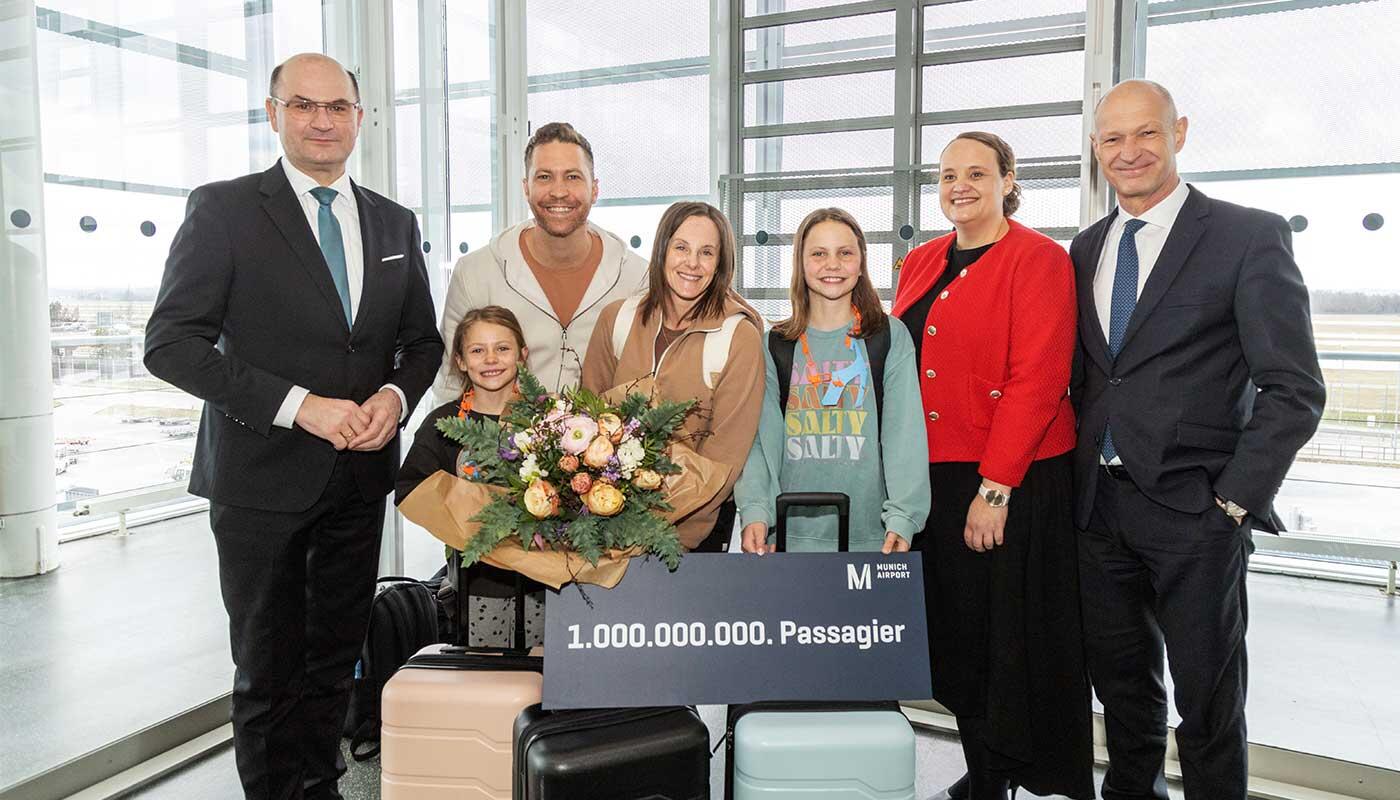
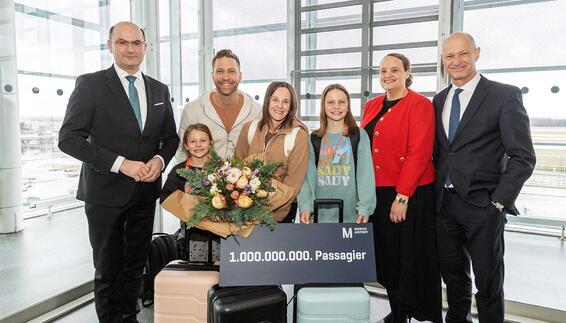
Munich Airport reached a special milestone in passenger numbers today: At noon, the airport welcomed its one-billionth passenger since it opened in 1992. The airport celebrated this symbolic moment together with its partner, Lufthansa. This significant milestone marks Munich Airport’s transition into one of Europe’s leading aviation hubs, serving approximately 100 airlines and offering global connections.
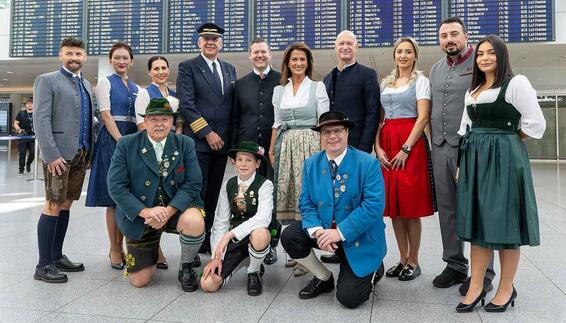
The one-billionth passenger was Amanda Walls, who was traveling with her family and was welcomed directly at the gate in Terminal 2 of Munich Airport by Albert Füracker, Chairman of the Supervisory Board of Munich Airport; Jost Lammers, CEO of Munich Airport; and Roswitha Becker, Vice President of Operations at Lufthansa Airlines in Munich. To mark this special occasion, the family received vouchers for visits to the Lufthansa Senator Lounge and the airport brewery Airbräu, as well as a voucher for airport parking.
Minister of State Albert Füracker emphasized the significance of this milestone: “One billion passengers represent over three decades of successful regional development in Bavaria. Munich Airport is a central pillar of infrastructure in the Free State and Bavaria’s important ‘gateway to the world.’ Through its partnership with Lufthansa, the airport has developed into a major European aviation hub and a five-star airport. Today’s milestone underscores the airport’s performance and its importance to our state’s economy, tourism, and employment. My thanks go to everyone who works tirelessly every day to make this possible.”
Munich Airport CEO Jost Lammers said: “The one-billionth passenger is, above all, a sign of appreciation for the work of our employees. They have guided Munich Airport through many years of growth and challenging times, bringing the vision of a premium hub to life. This moment also serves as an incentive to continue developing Munich Airport in a quality-oriented and sustainable manner.”The close partnership with Lufthansa was also a key factor in the airport’s success. Roswitha Becker, Vice President of Operations at Lufthansa Airlines, added: “We are delighted to fly Mrs. Walls to Munich, Bavaria’s premier hub, as the airport’s one-billionth guest. The successful collaboration between FMG, the Free State of Bavaria, and Lufthansa is unique and special. It forms the foundation of this airport’s remarkable history. We will continue to work closely and collaboratively to enhance the airport's appeal to passengers from around the world."
The first landing was not planned that way
The airport’s journey to its one-billionth passenger began on May 17, 1992, when flight operations commenced at its current location in northeast of Munich. Unlike the original plan to open the new airport with two Lufthansa planes landing simultaneously, the first aircraft to touch down that morning was a charter flight from Aero Lloyd. The McDonnell Douglas MD-83 arrived from Izmir, Turkey, and thus went down in history as the first aircraft to actually land with passengers at the new Munich Airport.
The arrival of the first passengers marked the beginning of the airport’s transformation into an international aviation hub. Shortly after Germany’s reunification and the end of Europe’s decades-long division, Munich Airport was able to fully capitalize on its central location in the heart of the continent. What started as a new international airport has evolved into a premium hub with global connections. Today, it plays a central role in passenger mobility, Bavaria’s economy, and international air traffic.
Bayern's Premium Hub is one of the largest in Europe
Today, Munich Airport is one of Europe’s most important aviation hubs, connecting Bavaria with over 230 destinations in more than 70 countries. Thanks to its commitment to quality, its operational efficiency, and its international focus, the airport has established itself as a major player in global aviation. Munich Airport recorded significant traffic growth in 2025. A total of 43.4 million passengers traveled through the Bavarian aviation hub. The number of flight movements also showed a positive trend, with approximately 337,000 takeoffs and landings - three percent higher than the previous year. The average seat load factor reached 80.9%, confirming the high demand for air travel. Last year, air cargo volume surged by ten percent to 340,000 tons, surpassing pre-crisis levels by two percent.